
By [Rajesh Bhatta], Rescue Specialist — Mountain Helicopter Nepal. Published [September, 2026] | [6 min read]
Nepal is a country you can't cross by road. Not really. Between the capital and the farthest folds of the Himalaya lie villages that are weeks from any hospital, valleys that vanish under landslides every monsoon, and high passes that freeze solid every winter. And yet life goes on there; babies are born, workers break ground on roads and power plants, and grandmothers climb on pilgrimages to temples older than the hills, and somewhere in every one of those places, someone will fall ill on a day when the ground refuses to help.
That's where we come in. For millions of people across Nepal, the helicopter is not a tourist machine. It's an air ambulance, a flying rescue team, and a 24/7 emergency line that answers in the small hours when nothing else can. It's the difference between reaching out for help and reaching out too late.
I have been doing this work for years now, and still, every mission humbles me. People assume our job is rescuing tired climbers from a mountain. Some days it is. But most days it's something far closer to home. A mother in labor in a district above the clouds, where the only health post has no surgeon. A worker pinned under rubble on a road project in the mid-hills. A pilgrim whose heart gives out on the long climb to Muktinath, surrounded by strangers who have become family by the time the rotor sound reaches them. A neighbor's child is sick enough that a district hospital has done everything it can and can do no more.
When the ground won't deliver someone to a hospital in time, the sky is the only road left. And on that road, we are the ones who drive.
The Same Machine, Wearing a Different Meaning
There's a strange thing about our helicopters. The very same aircraft that carries sightseers above Everest on a sunny morning is the one that, the next day, carries a stranger's entire world inside a stretcher. Same pilot. Same sound. Different weight in the cabin.
I've stood on helipads in every corner of this country: in Kathmandu, in Pokhara, on the narrow strips of the high Himalayas, and in the remote districts where our rescue helicopters are the only link to a hospital bed. And I've learned that a helicopter rescue is never one moment. It's a chain of small mercies, each one holding the last together. Someone makes the call. A health worker, her voice composed on a line that keeps cutting out, describes what she can't handle alone. A family member gives coordinates with a shaky hand. An insurer clears the flight without dragging their feet. A doctor at the receiving hospital has already told his team to expect you. And the crew who sacrifice their own lives to bring it all home.
Our search and rescue teams track patients by GPS, home in on a village that might be a single cluster of roofs in a sea of ridge lines, and land where the map says nothing exists. In the air, oxygen flows, vitals are watched, and a patient is never alone with the mountains. We don't get to see the endings of most of those stories. We hand the patient over at the hospital and turn for the next pad. But sometimes, the endings find us anyway. The message that arrives two weeks later, the photo of a smiling face, and the single word "dhanyabad" that makes every early morning and every anxious mile worth all of it.
From the Low Hills to the Roof of the World
If asked where we fly, the honest answer is everywhere a road stops being useful.
In the mid-hills, Sindhupalchok, Gorkha, and Dolakha, the mountains are close enough to Kathmandu to tease you. You can see the city from ridge to ridge. But when the monsoon takes the highway, when a landslide swallows a bus, and a dozen people need a hospital in the next hour, the teasing distance turns cruel. The helicopter does in twenty minutes what no vehicle, no porter, and no effort can do in a day.
In the far west, Humla and Mugu push against the border of Tibet in a silence that feels ancient. The clinics there treat what they can with what they have. For everything else: a complicated birth, a bad heart, a fever that will not break, the medical evacuation flight is long, high, and planned with the care of a major undertaking. And it is often the only option a family has. When we land there, children run out to watch, and their parents come with hope written raw across their faces.
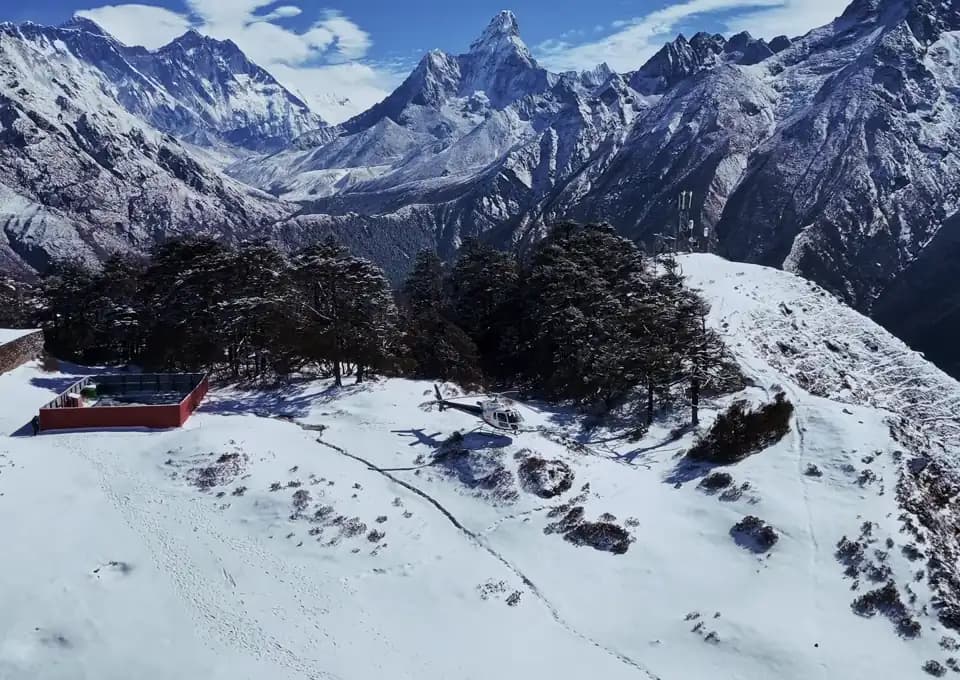
In the high Himalaya, the trekkers and climbers appear. Everest, Annapurna, Langtang, Manaslu, Mustang, and beyond into the silence of Kanchenjunga and Dolpo. Our crews know those valleys the way a farmer knows his fields — every landing spot, every wind shadow, every place the clouds gather by afternoon. Acute mountain sickness, from a stubborn headache to the fluid-filled lungs of HAPE or the swelling brain of HACE, does not care why you're there. It takes the tired and the fit alike, and when someone is slipping beyond what descent alone can fix, the machine in the sky is the difference between a story that ends on a mountain and a story that ends at home.
And in the capital itself, our own city, the work carries on. Moving a patient between hospitals when the roads are a river of traffic. Carrying oxygen or medicine to a district cut off by flood. Reaching a valley the morning after an earthquake turned the earth to water. Rescue is never only a mountain thing. It's a Nepal thing.
The Weight of the Words We Must Say
I want you to trust what I say next, because it comes from the part of the work nobody puts on a poster. We are not magic. There are mornings we cannot fly, and saying so breaks my heart every single time.
Fog sits thick in the valleys and will not lift. Snow covers the passes in drifts the color of silence. Storms come up without warning, faster than any forecast can predict. On those days, every pilot in Nepal makes the same call, because adding a second casualty to a rescue is the worst outcome there is. The people waiting on a ridge, watching the sky, deserve better than our hope—they deserve our judgment. And judgment sometimes means waiting for first light.
The altitude bends the rules of physics. The higher we fly, the thinner the air, the less the machine can carry. A helicopter that lifts six people in Kathmandu lifts far fewer above five thousand meters, and on the highest missions every kilogram carries a conversation with it: oxygen cylinders, medical equipment, crew, and patient. Weight, we can account for. What we can't account for is what we can't predict.
And there are places where even a landing is impossible. Steep faces, narrow ridges, ground that falls away in every direction. When the skids can't set down, we lower a crew member on a line: a long, careful, exacting dance between pilot and rescuer and wind, until the patient is lifted free of the mountain and into the machine. Longline and winch extraction are slower and harder, and they demand a team at its finest. I am proud of every person who has ever hung from that line to bring someone up.
None of these limits are secrets among us. The safety standards we fly by are the same in the far west as they are above Everest. Every pilot on our roster is trained for mountain flying; every crew member is certified for the air. We live with these constraints daily. But we also know this: preparation closes the gap. The emergency number is saved on a phone before the last signal goes quiet. The insurance coverage includes helicopter evacuation and medevac, so no family has to choose between their savings and their mother. The clear location is repeated twice so the pilot doesn't have to search. Every one of those small things is a mercy we can carry with us into the wind.
Why We Do It
I have been asked, more times than I can count, what keeps someone in this work. The pay is not the answer. The hours are not the answer.
It's the families. It's watching a daughter stand a little straighter when she hears the rescue helicopter is coming for her father. It's a village that lines the helipad in silence, and the murmur of relief that rises the moment the aircraft lifts off with its patient safe inside. It's the pilgrim who will tell the story of being carried home for the rest of her life. It's knowing that in a country this rugged, in a land this vertical, there is something that reaches across the distance, not to make the distance disappear, but to cross it when crossing it is everything.
That is the real promise of the helicopter in Nepal. Not that the mountains and the valleys and the long distances are safe. They aren't, and pretending otherwise would be a lie. The promise is simpler and stronger: That help is never beyond reach. That the sky, on the worst day, is still open. That someone, somewhere, is listening for the call.
So wherever you are in this country: on a trail in the high Himalayas, in a village the road forgot, at a worksite in the hills, or in the middle of a city that never stops moving, know that the machine above you is more than a machine. It is a thousand small mercies, holding together, on its way to you.
And when you see it coming, carry your hope out to meet it. Because on the other end of that flight is everything; we do this for it.
Mountain Helicopter Nepal provides nationwide helicopter rescue, air ambulance, and medical evacuation—24 hours a day, 365 days a year.
Book your seat: +977 9801062087 | mountainhelicopter.com.np/book Morning departures. The sharpest light, the calmest winds, and the clearest skies are all before noon.