- By Mr. [Samish Khatiwada], Senior Tour Consultant — Mountain Helicopter Nepal. Published [September, 2026] | [6 min read]
People ask me this more than anything else. Usually it comes right after, "How much does it cost?" and usually it comes from someone staring at a calendar and trying to make the hardest decision of their trip. When should I fly over the Himalaya?
Here is the honest answer, from someone who sits at the front of the machine and watches the weather every single day of the year. There is no bad month to fly in Nepal. There is only the right month for what you want to see, and the right month changes depending on the person. Some people want Everest on a postcard. Some people want green valleys and empty trails. Some people just want to get somewhere safely, because no road can take them. All of those are different months, and all of them exist in Nepal.
So let me walk you through the year, one month at a time, the way I see it from the cockpit.
There Are Two Seasons That Rule Everything
Before the months, learn the two words that explain the whole country: autumn and spring.
Nepal has two clear flying seasons, and they are the mirror of each other. The first is October and November, right after the monsoon has washed the sky clean. The second is March through May, when the air is warming up and the mountains are showing off in spring light. Everything else sits in between.
The cleanest, most reliable flying in all of Nepal happens in these two windows. That is not a secret. It is the reason the trails, the hotels, and the helipads fill up at the same time every year.
Autumn: October and November
October is the month. If I had to put one month on a poster for helicopter flying in Nepal, it would be October.
The monsoon ends around the last week of September, and it leaves behind something you cannot buy anywhere else. The sky goes a deeper blue. The mountains stand out of the haze as if they were painted on glass. Everest, from the air, looks close enough to touch, and the light at morning is so sharp you can count the ridges. Visibility is outstanding, temperatures are comfortable, and the whole country is dry. It is why the trekkers come in their thousands, and it is why October books out faster than any other month.
November keeps the same clear skies but turns the temperature down. Mornings are crisp, sometimes cold, and the air stays so clean that the high peaks are still spectacular. What you trade is warmth. Nights at altitude go properly cold, and the higher valleys can see frost. For flying, it is still excellent. You just pack a warmer jacket.
If you can choose freely, choose October. If you want the same views with fewer crowds and don't mind the cold, November is your month.
Winter: December to February
This is the month people worry about, and it never needs to be worried about as much as people think.
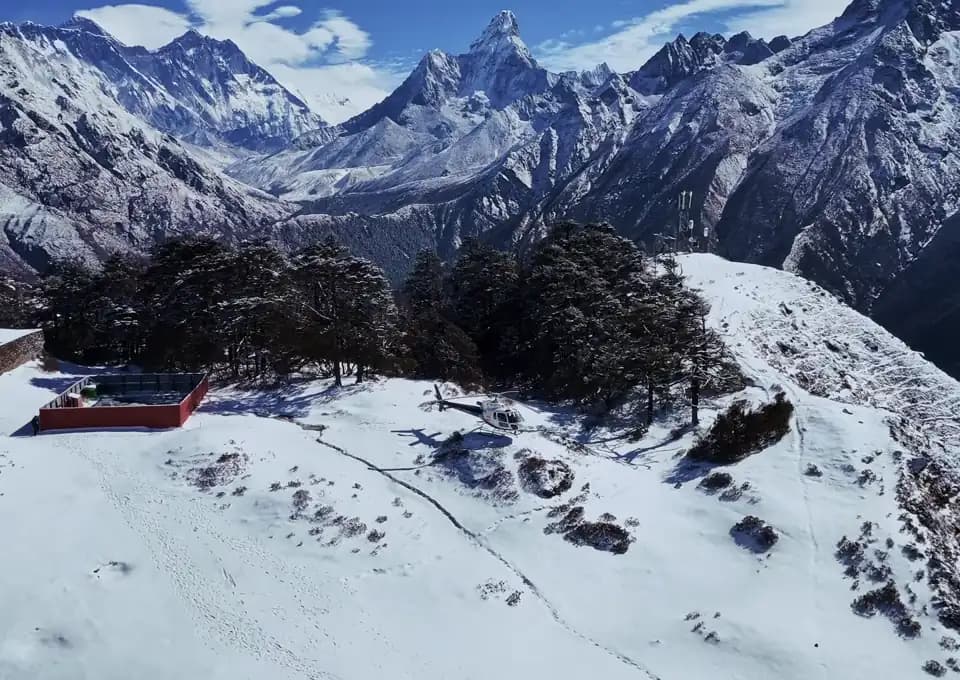
Winter in the Himalaya is not flying-season weather the way autumn is, but it is far from impossible. The mountains get less traffic, the sky stays clear and dry on most days, and for anyone who wants solitude, this is a quiet miracle. Cold is the real story. Kathmandu mornings can be foggy until the sun burns it off, so we fly later and land earlier. At higher altitudes, temperatures stay well below freezing, and the passes can hold snow for weeks.
The trick with winter is the mornings. Fog sits low in the valleys, and we simply wait for it to lift, usually by mid-morning. Once it clears, the flying is often beautiful, with the snow blue and the ridges quiet. Some routes close; the high mountain landings get harder. But the core of Nepal, the valleys, the resorts, the Everest and Annapurna viewpoints, they fly almost every day of December if the wind allows.
February is the bridge month. The cold eases, the days lengthen, and the first signs of spring arrive in the hills. Skiers and winter lovers love it. Everyone else starts counting down to spring.
Spring: March to May
Spring is the second great season, and in some ways it is the most beautiful of all.
March warms everything up. The snowline climbs, the trails open, and the rhododendrons start their great bloom. Soon the whole mid-hill country turns pink and red and white with them. Everest climbing season starts quietly, and the air is still clean enough for outstanding flights. This is my personal pick if you want color on the ground along with the giants in the sky.
April is the peak of spring and the peak of the climbing season. The weather is warm, the skies are mostly clear, and Everest Base Camp is a working city of tents and snow. Helicopter flights into the mountains run constantly. It is also the month where the afternoon clouds start to build a little more, so the old rule applies harder: go early, and you get the perfect sky. By lunchtime the valleys can start to dress in clouds.
May is the month of the big summit push, and the month the season starts to give way. The weather holds for much of it, and watching the climbing world move toward the top of Everest from the air is something you will never forget. But the heat builds, the days get hazier, and by the last week the first monsoon clouds start loitering on the horizon. Fly early in May and you are golden. Fly late in May and you are gambling.
Monsoon: June to September
This is the season nobody posts about, and it is the season I know the best, because it is when the helicopter becomes a lifeline.
From June, the monsoon rolls up from the south and the country turns green and wet. Rain falls most days, especially in the afternoons. The clouds sit low over the valleys, and for tourists the flight decks quiet down. But listen to what the helicopter is doing in these months. It is flying where the roads have vanished into landslides. It is reaching villages cut off by flooded rivers. It is moving sick people, pregnant mothers, and injured workers out of valleys that have become prisons of mud and water.
Monsoon flying is a different discipline. It is done in windows, often in the early mornings before the clouds build, and it is done by pilots who know exactly where the weather has room to breathe. The high Himalaya is actually less affected than the mid-hills, because much of the range sits above the monsoon clouds, and some valleys north of the mountains stay almost dry all summer. You can still fly in these months. You just have to fly smart, fly early, and fly with people who have done it a thousand times.
August is the wettest month, and September is the reluctant handover, when the rain begins to break and the first clear windows appear. By the last week of September, the sky starts to remember itself, and the country prepares for October.
The Month-by-Month, at a Glance
So here is the whole year, in a handful of lines:
January. Cold, clear, quiet. Foggy mornings, beautiful afternoons.
February. Still cold, first hints of spring. Solitude and blue skies.
March. Warming up. Rhododendrons bloom. The season turns.
April. Peak spring. Warm, clear, Everest teams on the move. My pick for color.
May. Summit season. Beautiful early, hazier late. Fly in the first half.
June. Monsoon begins. Wet afternoons, early-morning flying only.
July and August. Deepest monsoon. Best for rescue work, heavy weather for tourists.
September. Rain fades. First clean windows appear. The country dries out.
October. The perfect month. Clearest skies of the entire year. Book early.
November. Clear, cold, fewer people. Nearly as good as October.
December. Winter returns. Cold and quiet, still flyable most days.
What I Tell Everyone Who Asks
If you are planning a once-in-a-lifetime flight, book October, or April if October is full. If you want the same views without the crowds and with a proper jacket, try November or March. If you want the Himalaya all to yourself in winter cold, December and February will reward you. And if you are flying in the monsoon, do not worry. We fly all year. We simply fly by a different calendar, one measured in early mornings and honest weather.
One rule beats every month on this list, and it is the rule I close with every time. Fly in the morning. The light is sharpest at first light, the winds are calmest before noon, and the clouds, whatever the season, always respect the morning more than the afternoon. Come early, fly early, and let Nepal do the rest.
Because there is a version of this country for every month of the year. Each one is beautiful. Each one is worth seeing. And whichever one you choose, we will be waiting at the helipad before the sun gets there.
Mountain Helicopter Nepal — full-service helicopter tours and rescue flights across Nepal, every month of the year.
Book your seat: +977 9801062087 | mountainhelicopter.com.np/book Morning departures. The sharpest light, the calmest winds, and the clearest skies are all before noon.
