
By Captain [Anton Dotti Eklund], Senior Pilot — Mountain Helicopter Nepal Published [September, 2026] | [6 min read]
People ask me this all the time, usually at the check-in desk or just before we board: what is a helicopter tour in Nepal actually like? They've seen the videos. They've saved the photos. But they always want the real answer, from someone who's done it a thousand times.
Here it is.
There is a moment in nearly every tour when the passengers go quiet. It happens at the same place, on every single route, in every type of weather. The machine settles into its rhythm, the valley drops out from under the skids, and the first peak of the Himalaya rounds into the window. Nobody talks. Not even the loud ones. And that silence, more than anything else, is what I want to tell you about.
Where It All Begins
Every tour starts the same way: morning, a helipad, and the sound of the turbines waking up.
Whether we depart from Kathmandu, from the lakeside helipads of Pokhara, or from a small town sitting in the cold valley air, the first few minutes look alike. Passengers are checked in, weighed, and handed their seats. I always tell them to take the window seat, and they always look at me like I've said something profound.
Then the rotor builds, the ground crew steps back, and the machine rises. There is nothing in the world like a helicopter takeoff. A plane climbs forward, away from you. A helicopter simply lets go, the earth falls away, clean and deliberate, as if it has decided to hand you over to the sky. Passengers hold the armrests on the first lift. By the third, they're leaning into the glass.
A Country, Unfolded Like a Map
This is when you understand why a helicopter tour is different from anything else in Nepal.
In the first few minutes you watch Kathmandu shrink from a living city into a quilt of rooftops and terraces and white roads winding between the hills. Then the ridges begin — layer after layer, folding into blue distance. From the ground you can't see it, but Nepal is not a flat country with mountains stuck at the edge. Everywhere, always, the land keeps climbing.
I've flown these valleys for years, and I still catch myself looking down. The rivers throw silver loops across the valley floors. The terraces cling to slopes that look too steep to farm. Villages appear: a scatter of tin roofs in a fold of green, and your guide will point them out the way children point at animals in a zoo. There is so much of this country that the road simply never reaches.
The First Peaks
Then comes the moment I told you about.
The air changes to a different kind of blue. The ridges sharpen into something older. The snowline appears, sudden and white, and a great silent mountain fills the forward glass: so close, so enormous, that the passengers stop thinking in photos and start thinking in feelings.
Every region does this differently.
On the Everest helicopter tour, we cross above the Khumbu, our route taking us north of the valleys where the great treks begin. We fly past the peaks that have names trekkers memorize for years, and we set down at Everest Base Camp or Kalapathar, where the highest mountain on the planet sits on the horizon like it's been waiting for you. Passengers have cried there. I have seen it more than once, standing on the snow, a grown adult holding back tears at the sheer size of what they're looking at.
Above Annapurna, it's a different kind of wonder. The great wall of Machapuchare rises over a turquoise valley, and the whole range leans into the sky like it's showing off. We land at Annapurna Base Camp when the weather allows, or circle above the Manang valley where the Annapurna Circuit trekkers are days from a road, and minutes from us.
On the pilgrimage flights to Muktinath, the mood is quieter, more reverent. Elderly passengers, many of them on a once-in-a-lifetime journey, step out onto the high plateau and walk the last steps to the temple the way their ancestors did on foot. You can feel it in the cabin, a tour for the eyes becomes something for the soul.
And on the shorter scenic flights from Pokhara, we stay closer to home, threading the foothills, crossing the valley lakes, and giving first-time flyers a taste of the mountains without the long route east. That's the one I recommend for people who want the feeling without the commitment.
The Silence Up High
There's a place on every route where we fly through or above the clouds, and this is where the cabin does its most beautiful thing.
The valleys go white beneath us. The world becomes two colors: the blue above, the clouds below, and the helicopter in between like a small, purposeful thing. In those minutes the noise of the machine becomes background, and the silence inside is complete. Not a nervous silence. A finished one. As if each passenger has stopped trying to understand what they're seeing and simply let it in.
People tell me later they weren't thinking about anything. That's the rare gift: a full hour or two with no screens, no traffic, no inbox, just the sound of a turbine and the edge of the world sliding past.
The Landing That Feels Like Borrowed Time
Helicopter landings in the high Himalaya are careful, precise things.
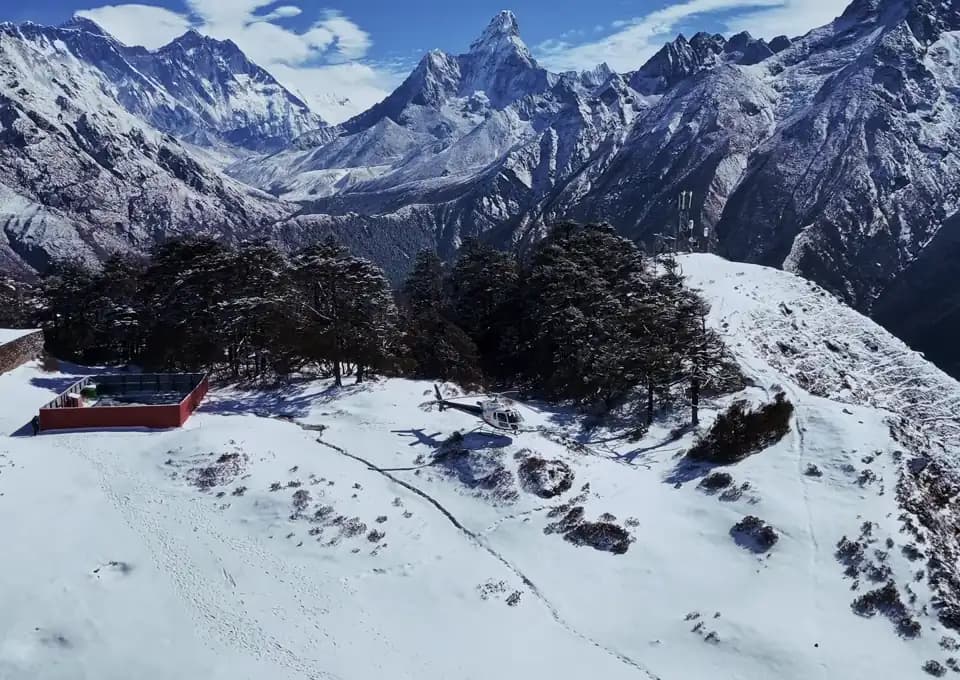
The skids touch down in one smooth motion on snow or gravel or a ridgeline barely wide enough to hold us. The rotor slows, the sound eases, and the silence that follows is so complete it almost rings. Passengers step out into cold, thin air and stand, grounded briefly at a place they have no business reaching on foot.
This is the part I watch the most from the cockpit. The photos come out, of course. But then the cameras lower, and people drift apart from each other, and they look. At the mountains, at the valley, at themselves standing in it. I've learned not to hurry anyone on those landings.
Sometimes, on the way down, we pass a trekking party on a trail below, tiny figures waving up at the machine. Passengers wave back, and there's a strange connection in it: two ways of crossing the same country, one on foot, one on the rotor.
Coming Home Changed
The return flight is always quieter than the outward one.
Outbound, the cabin is excitement. Inbound, it's holding something. The same valleys we crossed before have become meaningful: you've been up there now. You've stood in the thin air and looked out at a world that hasn't changed its size while you've changed yours. It's a strange thing to carry, and everyone carries it slightly differently.
By the time we set down and the crew opens the door, a three-hour tour can feel like twenty minutes. Passengers step out a little unsteady: the altitude does that, and they almost always do the same thing: a long look back at the machine, as if saying goodbye to something they didn't expect to love.
What I Tell Everyone Who Asks
So when people ask me what a helicopter tour in Nepal is really like — before they book, before they reserve their seat, before they decide between Everest and Annapurna — I tell them this.
It's not about the convenience, though the convenience is real. It's not about the time you save, though you'll save days. It's the one way to see the whole country at once: the valleys connecting, the villages lying along the ridges, the Himalaya as a wall of the world, standing patient and older than anything else you'll ever touch.
Come early, when the morning light is sharpest. Take the window seat. Bring a warm jacket and a charged camera. And let the mountains do the rest.
Because there are experiences you remember for a week, and there are experiences that rearrange how you see the world. A helicopter tour above Nepal belongs firmly to the second kind.
That's the honest answer. And I should know — I sit at the front, watching that moment happen, every single time.
Mountain Helicopter Nepal — helicopter tours across the Everest, Annapurna, Manang, and Muktinath regions, plus scenic flights from Pokhara and Kathmandu Valley sightseeing.
Book your seat: +977 9801062087 | mountainhelicopter.com.np/book Morning departures recommended. Window seats go first